
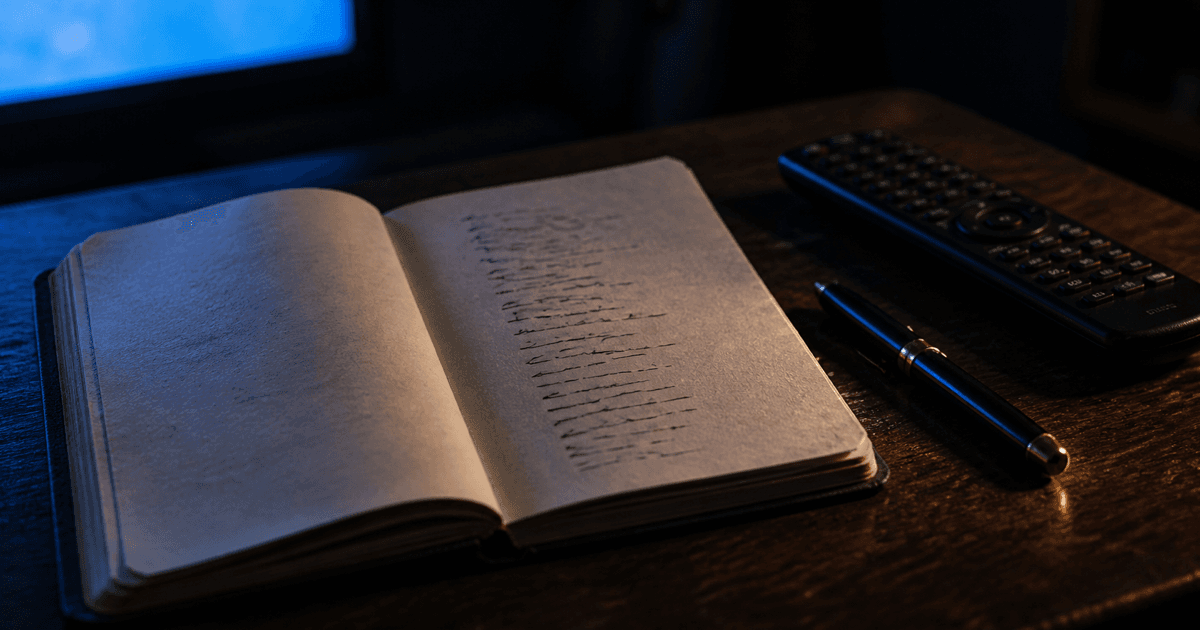
My wife has written down every movie we watch together since 2023.
The notebook is Annie's. I have never carried it, never written in it, never kept it near me. Every night we watch something, she writes the title down after it ends. No dates, no scores, no notes, just the title in the order it happened. Three years of that came to 235 films, and for a good number of them I would not have remembered we watched them at all.
We are not short on technology in this house. A Plex server sits in the next room holding every film we cared enough about to rip. Annie still reached for a pen, every night, for three years, and I never once thought about why.
We get two hours, and the menus eat twenty minutes
Finding a movie was never the hard part. Finding one with enough evening left to watch it was.
Two hours is the real budget on a weeknight. Turn the TV on, open one app, scroll a wall of posters, decide nothing, open a second app, scroll again. Twenty minutes are gone and nothing is playing, and now the film we were leaning toward runs too long to start. The nights that worked were the ones where we already knew what we wanted before we sat down. Browsing is not free. It comes out of the same two hours as watching.
Every service recommends from its catalog, not from your taste
Streaming recommendations answer a question nobody in this house asked. Ours pitches Jim Carrey movies at a household that has never watched one, and pitches a film we finished three days ago. The algorithm is working exactly as intended, aimed at a goal that belongs to someone else's quarter.
None of it knew the one thing that mattered on our couch: the 235 films we had already sat through together.
So I built the thing that would. It reads Annie's list and the Plex library as one input, then hands back a small round of picks instead of a wall of posters, with the reasons attached so we can push back on them. Corrections go in as plain sentences and carry forward into the next round.
The notebook only counts the nights we both sat down
A viewing history records that an account pressed play. It counts the show that ran while nobody was in the room, the next episode autoplay started after we had gone up to bed, the thing one of us put on alone at noon. It counts one profile shared by two people with different taste. Netflix has years of that on me, and most of it is noise.
The notebook records one thing. Annie writes down the movie the two of us sat down to watch that night, at the end, one line, in the order it happened. The ones we loved are on there. So are the ones we disliked, and the ones we drifted out of before the credits. Something we killed in the first few minutes probably never got written, because the night went somewhere else after that.
There are no ratings and I never wanted any. The watch is the signal. Two people picked this film out of everything available to them and gave an evening to it. That is enough to go looking for more like it, which was the only job I ever had for the list. Two hundred thirty-five lines of it, written by hand, with nothing in it for anyone to optimize.
The first version gave us nothing but music movies
The first version of the app came back almost entirely feel-good musician stories. Eurovision Song Contest: The Story of Fire Saga. Sing Street. Wild Rose. Fictional stories about people making music, round after round, whatever went in. Nothing set it off. No pick had landed yet that it could have been chasing. That was just what the early build did.
It also recommended two films we had already seen, Once and Begin Again.
I did not write a feature to fix it. The app has memory, so a correction goes in as an ordinary sentence and carries into the next round. Ease off the music. Tonight we want space operas. It still hands us a music movie now and then, and that is fine, because pushing back costs one sentence instead of a code change.
The most valuable input in this system so far came from ordinary conversation, not from a button press or a star rating. It is not one fix that held. It is steering, round after round, in the same language we already use to say what we feel like watching.
Anyone with a list and an API key could build this
Netflix could ship it next week. So could Prime. Here is what we watch, find more like it. There is no invention in that sentence and not much sophistication under it either.
It does not need any. Finding one film for a Tuesday is a low bar, and services with thousands of engineers clear it less often than a notebook nobody wrote software for. The technical problem is not what defeats them. They are solving a different problem, in public, every time a home screen loads.
Your workaround is the spec
If you have kept something by hand for three years, it is not a chore you never got around to automating. It is a product brief, and a more honest one than anything you would have written in a planning document, because nobody was building anything at the time.
The app keeps the one thing a shared streaming profile throws away, which is two people instead of one. Thumbs go in per person, so Annie and I register separately rather than averaging into one bland profile that suits neither of us, and that signal is thin now and compounds.
The valuable part of this project was never the model. Anyone can rent one of those by the hour. The valuable part was 235 lines of handwriting that nobody thought of as data.
Go look at what you already write down.